
eine Nachricht hinterlassen
Wenn Sie an unseren Produkten interessiert sind und mehr Details erfahren möchten, hinterlassen Sie bitte hier eine Nachricht. Wir werden Ihnen so schnell wie möglich antworten.


Industrial cooling water systems serve as the core heat dissipation unit for production facilities in chemical, power, metallurgical and other industries, and their operational reliability directly determines the continuous operation of main process equipment. Different from ordinary water pipelines, cooling water systems feature complex structures including open cooling towers, closed circulation pipelines, standby bypasses and spray water distribution systems, with a large number of pipelines, water collection pans and valves arranged outdoors. In low winter temperatures, static retained water and residual spray water are highly prone to freezing, which will not only cause pipe expansion and cracking, but also trigger chain accidents such as cooling capacity failure and main equipment overheating shutdown. Traditional passive insulation can only reduce the heat dissipation rate and cannot offset heat loss under extreme cold. As an active temperature compensation solution, the electric heat tracing system delivers accurate freeze protection for multi-form structures of cooling water systems and ensures stable operation of the system under all working conditions.
1. Core Freeze Damage Risks and Particularities of Cooling Water Systems in Winter
(1) Freeze expansion damage caused by static retained water
When cooling water systems are shut down, on standby or operating at low load, a large amount of static water will remain in pipelines, cooling tower water collection pans and filter chambers. Water expands by approximately 9% after freezing, generating internal stress of hundreds of megapascals, which is strong enough to burst carbon steel pipes, cast steel valves and flange sealing surfaces, and even cause weld cracking of cooling tower water collection tanks. Unlike continuously flowing process pipelines, cooling water systems often operate intermittently, and the retained static water has a higher freezing probability and more prominent freeze damage risk.
(2) Multi-position freeze damage hazards of open cooling towers
Open cooling towers are high-incidence areas of freeze damage. At the air intake louvers of cooling towers, water vapor easily condenses and freezes on the blinds when encountering cold, blocking the air inlet passage and reducing cooling efficiency. Residual water in spray distribution pipes freezes, causing nozzle blockage and uneven water distribution. The water collection pan has a shallow water level and large heat dissipation area, which is very easy to freeze completely at low temperatures and damage the pan structure. Traditional insulation is difficult to cover special-shaped small parts such as grilles and nozzles, which easily leaves low-temperature dead zones.
(3) Standby circuit freeze blockage leads to loss of emergency capacity
Industrial cooling water systems are usually equipped with standby pumps and standby pipelines, which are required to be switched into operation at any time. If the standby pipelines are frozen due to long-term static water retention, the standby system cannot be started immediately when the operating circuit fails, which will directly lead to the interruption of the cooling water system supply. For high-temperature reaction devices and high-power electrical equipment, cooling interruption will trigger equipment over-temperature protection shutdown in a short time, and even cause permanent damage to the equipment.
(4) Chain production accidents caused by cooling failure
Cooling water systems undertake the heat dissipation function of core equipment such as reactors, compressors and transformers. Once pipeline freezing blockage or cracking causes the interruption of cooling medium circulation, the main process equipment will be forced to reduce load or shut down completely due to insufficient heat dissipation, which not only causes material scrapping and capacity loss, but also may cause safety accidents due to over-temperature of some high-temperature and high-pressure equipment. Cooling water leakage after frost cracking will also cause water accumulation and icing on the plant floor, deriving secondary safety hazards.
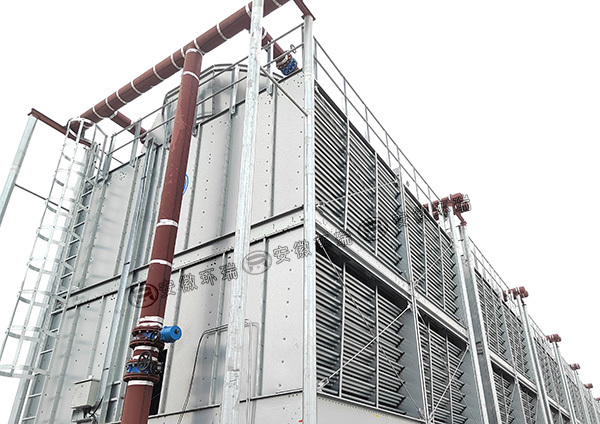
2. Technical Advantages of Electric Heat Tracing for Freeze Protection of Cooling Water Systems
(1) Full path coverage to eliminate low-temperature dead zones in special-shaped parts
Heat tracing cables can be laid along straight pipes, elbows, valves and flanges, and can also be flexibly arranged for special-shaped structures such as the bottom of cooling tower water collection pans, air intake louvers and spray branch pipes, so as to achieve uniform heat supplementation for small parts and corner areas that are difficult to protect with traditional insulation. In accordance with industry design specifications, power compensation can be carried out by increasing the tracing length for heat-concentrated parts such as valves and flanges to ensure no freeze protection blind spots in the whole system.
(2) Adapt to intermittent working conditions to ensure the system is always on standby
The electric heat tracing system can be equipped with ambient temperature sensors or pipeline temperature sensors to automatically start and stop heating according to the temperature threshold. For standby pipelines and intermittently operated cooling tower circuits, it can maintain a low-power heat preservation state for a long time, ensuring that the water temperature in the pipes is always above the freezing point, and can be put into use at any time without preheating, perfectly matching the standby ready operation requirements of cooling water systems.
(3) Precise temperature control and energy saving to avoid overheating energy waste
Cooling water freeze protection only needs to maintain the medium temperature above 5℃, without excessive temperature rise. Self-regulating heating cables have PTC power self-regulation characteristics: the lower the temperature, the higher the output power; the power automatically attenuates when the temperature rises. With a thermostat, the water temperature can be stabilized in the antifreeze range of 3-8℃, which not only avoids the risk of freezing, but also avoids invalid energy consumption. Compared with steam tracing, the comprehensive energy saving is more than 30%.
(4) Convenient retrofitting and installation without modifying the original hydraulic system
For cooling water systems already in operation, electric heat tracing can be directly laid on the outer wall of the pipeline without changing the original water pipeline layout or adding steam-water recovery pipelines. The construction period is short and the impact on production shutdown is small. After the system is put into operation, there is no leakage problem and no frequent maintenance is required, which is suitable for the freeze protection upgrade of old systems.
3. Key Points for Selection and Design of Electric Heat Tracing for Cooling Water Systems
(1) Product type selection: In accordance with the HG/T 20514 industry standard, cooling water freeze protection belongs to medium and low temperature maintenance scenarios. Self-regulating heating cables are preferred, with a maintenance temperature not exceeding 130℃, which can automatically limit the maximum temperature and avoid local overheating. For long-distance main pipelines, constant-wattage heating cables can be selected and used with a thermostat.
(2) Power matching calculation: The heat loss per unit length shall be calculated according to the pipe diameter, insulation thickness and local extreme minimum temperature. The nominal power of the selected heating cable shall not be less than the calculated heat loss value; for special-shaped parts such as valves and flanges, the power margin shall be designed at 1.2-1.5 times that of straight pipes.
(3) Environmental adaptation requirements: For cooling water pipelines in explosion-proof areas of chemical plants, explosion-proof electric heat tracing products of corresponding explosion-proof grade must be selected, complying with ATEX or domestic explosion-proof standards; heating cables laid outdoors shall adopt UV-resistant and waterproof sheaths, and outdoor junction boxes shall reach IP65 protection grade.
(4) Strengthening of key parts: The bottom of the cooling tower water collection pan shall be laid flat, heat tracing cables shall be arranged along the frame of the air intake louvers, and the spray branch pipes shall be spirally wound to ensure that the easily frozen parts get priority heat compensation.
Conclusion
Due to the characteristics of complex structure, intermittent operation and outdoor arrangement, industrial cooling water systems have higher winter freeze damage risk than ordinary water pipelines, and failures will be directly transmitted to the main production system, causing chain losses. With the advantages of active heat compensation, full path coverage, precise temperature control and adaptation to intermittent working conditions, the electric heat tracing system can effectively solve the problems of pipe cracking, cooling tower icing and standby circuit failure. It is a mature technical solution to ensure the stable operation of cooling water systems in winter and support continuous production operation.
 IPv6-Netzwerk unterstützt





eine Nachricht hinterlassen
Scannen Sie den QR-Code zu WeChat :
Scannen und zu WhatsApp senden :